
Irish Fracture Liaison Service Database National Report 2025

Irish Fracture Liaison Service Database National Report 2025 Image

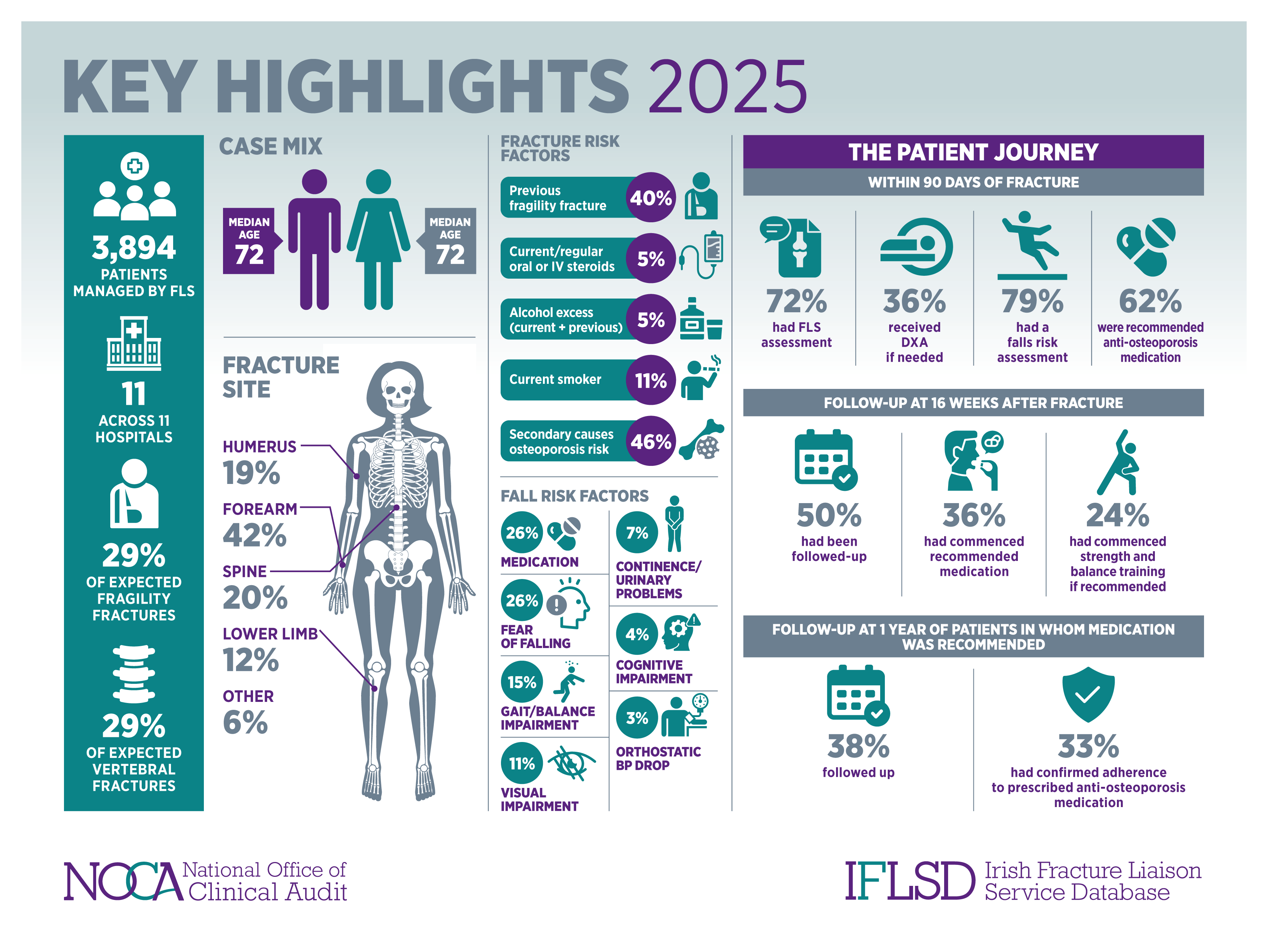
The Irish Fracture Liaison Service Database National Report 2025 presents data on 3,894 cases across 11 participating hospitals, examining the identification, assessment and management of patients who experience fragility fractures, with the aim of preventing further fractures. The first report published under the governance of NOCA, it highlights improvements in eight of the 11 key performance indicators compared with 2024, while identifying ongoing challenges in patient identification, timely assessment and variation in care across participating hospitals.


Key Findings

In 2025, participating Fracture Liaison Services identified 29% of the estimated number of non-hip fragility fracture cases, compared with 30% in 2024. Of patients identified, 72% were assessed by a Fracture Liaison Service practitioner within 90 days of their fracture, while 79% received or were referred for a falls risk assessment, an increase from 70% in 2024. The proportion recommended anti-osteoporosis medication increased from 57% to 62%, while 36% of patients requiring a bone density (DXA) scan received one within 90 days, up from 33%. Despite improvements in several areas of care, the findings highlight the need to strengthen patient identification, improve access to timely assessment and treatment, and reduce variation between hospitals.

Recommendations

Strengthen the identification of non-hip fragility fracture and vertebral fracture patients and support improved case ascertainment across participating Fracture Liaison Services (FLSs).

Participating hospitals will review local case-finding methodologies and referral pathways and identify opportunities to improve patient identification. NOCA will support this through benchmarking, identification of variation in performance, and sharing of learning and effective case-finding approaches across participating services.

Undertake a national organisational survey of participating and non-participating hospitals to establish a baseline of Fracture Liaison Service provision, identify factors influencing variation in service delivery and inform future participation in the Irish Fracture Liaison Service Database (IFLSD).

NOCA will administer an organisational survey that will gather information on workforce, governance arrangements, infrastructure, access to diagnostics and multidisciplinary team supports in participating services, and on current FLS provision and potential future participation in the IFLSD in non-participating hospitals. Findings will be published to support service evaluation, quality improvement and service planning, and to inform future development of the IFLSD.